Andy disembarked in Le Havre on 13 October 1917. He would have had a slow, stop-start trip to rejoin his battalion in Flanders. Constant rain and artillery bombardment had created a quagmire that made transport almost impossible. The few roads that were passable were targets for the enemy’s shrapnel and high explosive shells.
Blocks in the traffic were inevitable and constant. At times as far as the eye could see the main arteries of communication would be blocked … Whole teams of wagons were killed, to be dragged out of the way and the vehicle pushed into the mud, to allow the living to pass.
History of the 10th Battalion A.I.F.
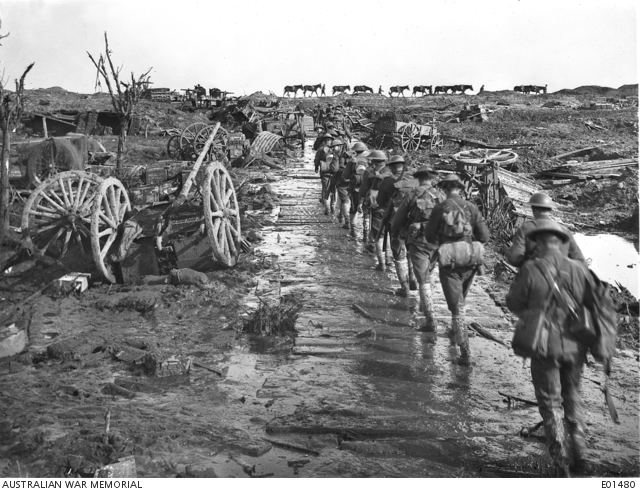
Australian War Memorial collection E01480
Andy reached his unit in the mud and the mire near Passchendaele on 16 October. Many of the faces he had last seen at Pozières were missing; dead or disappeared, perhaps prisoners of war. He arrived at the tail-end of the 3rd Battle of Ypres [Ieper], just missing the actions at Polygon Wood and the disastrous diversionary raid at Celtic Wood.

Australian War Memorial collection E01184
The activities of the 10th Battalion for the next few months reflected the nature of the war on the Western Front: small movements of just a few miles back and forth through rain, mud and icy weather; periods of action interspersed with relative quiet.
On 10 November Andy left Ypres with the battalion for the Boulogne area. After a month of training, rest and recovery, the battalion marched East and into the line at Messines [Mesen]. The weather was very cold. Flooded mine craters froze over.
In this area (though not always the same sector) the battalion remained until the beginning of April – sometimes out, but more often in the forward zone – and, though the sector was a quiet one, the fatigues which were long and tiring gave little rest for either officers or men.
History of the 10th Battalion A.I.F.
Andy was in the line until Christmas, when the battalion was relieved and came out to Wulverghem Camp, a few miles away. The men could not celebrate Christmas as they were still in a forward area, but spending Christmas day warm and dry would have been a welcome present.
The battalion remained in the Messines area for all of January, moving a short way north into the trenches at Wytschaete [Wijtschate] on 23 January. Andy spent a very quiet week here before the battalion moved to Aldershot Camp, where they finally celebrated Christmas on 16 February. Despite the relative quiet of the sector, there was the odd ‘stand to’ alarm raised, and the men would have to be ready for battle with 20 minutes’ notice.

Australian War Memorial collection E01593
On 23 February 1918 Non-commissioned officers of the 10th Battalion posed for a group photograph at Neuve Eglise [Nieuwkerke].
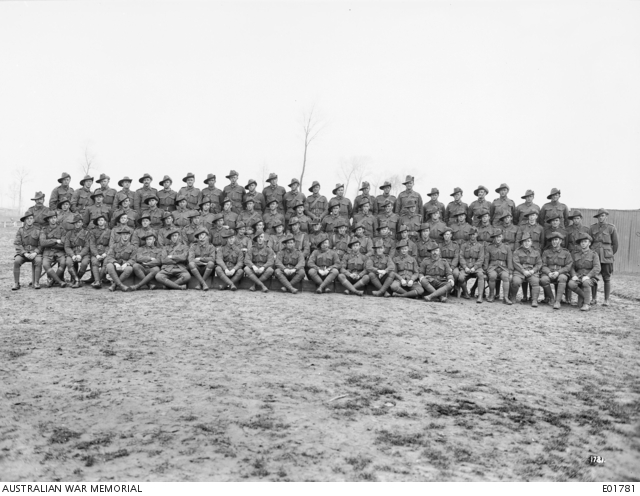
Australian War Memorial collection E01781

Seated in front of Andy on the left of frame is Corporal Reginald Roy Inwood, who was awarded the Victoria Cross for his actions at Polygon Wood in September 1917. Andy and Roy were both original 1914 Anzacs from Broken Hill.
Less than a week after this photo was taken Andy would be back in the trenches, where he would experience something for which he had never trained or prepared. His war was about to take a very different turn.
Sources
NAA: B2455, DUNCAN, AS. National Archives of Australia.
First World War Embarkation Rolls. Australian War Memorial collection.
Limb, A, 1919. History of the 10th Battalion A.I.F.. 1st ed. London; Melbourne: Cassell and Co.
Lock, C.B.L., 1936. The Fighting 10th: a South Australian centenary souvenir of the 10th Battalion, A.I.F., 1914-1919. Webb & Son, Adelaide. Reprinted in 2000 by The Naval & Military Press in association with The Imperial War Museum
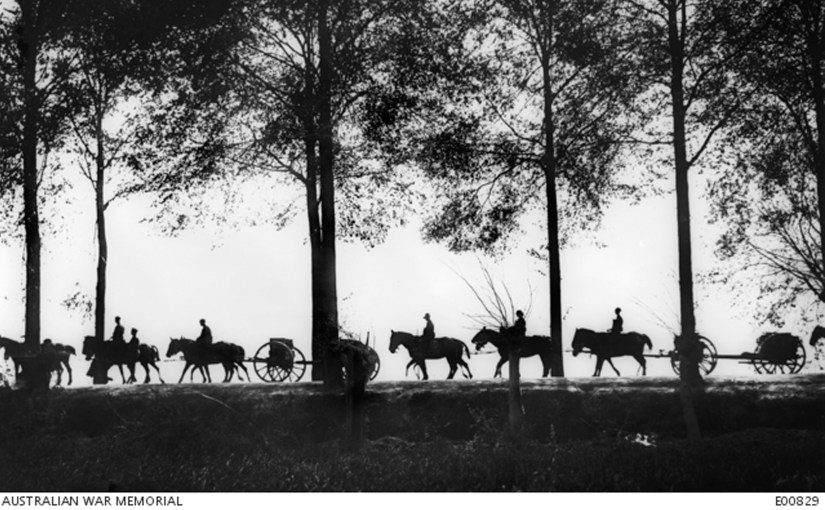
Featured image: A view, in silhouette, of Australian artillery limbers loaded with ammunition proceeding along the Ypres Road. Australian War Memorial collection E00829










 Andrew's Archives